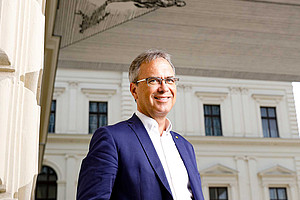
Climate researchers Gottfried Kirchengast and Stefan Schleicher from the Wegener Center at the University of Graz have produced a prediction of Austrian greenhouse gas emissions in 2025 based on data available up to October 2025, including data for natural gas and petroleum products, among others. “According to our results the emissions, measured in million tons of CO2 equivalent, will be around 2.5 percent higher this year than last year. This corresponds to an increase of 1.7 million tons and essentially negates the reduction achieved in 2024 compared to 2023,” reports Kirchengast. The estimated uncertainty of the prediction is plus/minus two percent.
“The main reasons for the increase are the slowing pace in the expansion of renewable energies and in the reduction of transport emissions, as well as cooler winter months leading to more heating degree days, which further increase natural gas consumption,” explains the researcher, adding: “Particularly worrying is the increase of Austria’s share in international aviation emissions, which we computed as a complementary result. They rose to over six million tons of CO₂ equivalent in 2025. This amount now corresponds to one third of the emissions of the entire Austrian transport sector on the ground.”
The current increase marks the end of a hopeful trend: emissions had been falling steadily since 2021. “Climate action in Austria has somewhat stalled, even though research clearly shows that this delay will result in billions in costs and extensive damage. This is a real wake-up call for the government," says Kirchengast, who sees an urgent need for more effective climate policies.
Details on the forecast for greenhouse gas emissions in Austria in 2025 (German only)
Temperature rise can only be slowed by drastic emission reductions
Global warming is already very close to the 1.5-degree limit set by the Paris Climate Agreement. “Our prediction to this end, based on data up to November 2025, shows a long-term global surface air temperature increase of 1.48 °C by 2025,” says Kirchengast, who computed this forecast jointly with his doctoral student Moritz Pichler at the Wegener Center. The main cause of the rapid warming is the continuing high level of emissions. “Only a drastic reduction in greenhouse gas emissions can slow down this threatening development. At the same time, this opens up great opportunities for a more sustainable economy,” says the researcher, emphasizing the need for a profound reorientation. “We need ambitious climate action management at all levels. This ranges from clear framework goals set by policymakers and corresponding guidelines and incentives for companies to a climate-friendly lifestyle in our own personal sphere,” says Kirchengast.
Web portal on greenhouse gas emissions and climate change
Gottfried Kirchengast’s team continuously updates the publicly accessible web portal “Graz Climate Change Indicators – ClimateTracer” with the latest information on the development of greenhouse gas emissions, global warming and other important indicators of climate change. It offers reliable information for Austria, Europe and the entire world since 1960, as well as future scenarios up to 2050 based on the Paris climate goals.
All of this research is part of the Field of Excellence Climate Change Graz at the University of Graz.
Further links to the ClimateTracer web portal
Data on Austria's greenhouse gas emissions
Data on global warming